There was a time I thought owning a website was the coolest thing possible. This was also the time I thought running Linux on your PC was a personality trait.
Back when computers were furniture
Like most kids born in the 90s, my first encounter with computers was a huge CRT monitor hooked up to a loud tower PC running Windows 98. I spent countless hours playing My Friend Koo and Captain Claw, much to my parents' disappointment. There were no screen-time restrictions. You could play for as long as you wanted, until the computer sounded like it was preparing for takeoff or about to melt into a puddle of bubbling beige sludge.
Somewhere along the way we lost the PC. For the life of me, I cannot remember what happened to it. We didn’t have another computer in the house, apart from my parents’ work laptops, which I was absolutely forbidden from touching. I didn't think much about computers again until I was around ten, when my mother brought home a battered ThinkPad from her office's end-of-life refurbishment programme. This steaming pile of garbage had a Centrino Duo processor, 1 GB of RAM and no battery. But oh, how I loved my new not-so-lap-friendly laptop! It took about 20 minutes just to boot Windows Vista. Yes, Microsoft, we still remember what you did with Vista.
Childhood tech rabbit holes
This laptop opened up a whole new world of possibilities. For the first time, I had found something I was genuinely obsessed with: getting this thing to boot faster. I grabbed a screwdriver, opened it up, and quickly realised that what this machine desperately needed was more RAM. Unfortunately, convincing my parents to buy me more RAM was going to be a challenge, even if I claimed it was for school. Upgradable RAM. Now there's a concept I haven't heard of in a while. Looking at you, Apple. Anyway, I needed a workaround. What if I just changed my operating system? Vista was notorious for being resource-heavy, after all.
This eureka moment sent me headfirst down into the rabbit hole that was Linux. I was convinced all the cool people ran Linux, and that everyone who used it wore a cool hat, shades and a big overcoat while hacking into computers all day. Like most people trying Linux in the 2000s, I thought Ubuntu was the end goal. So I figured out how to dual-boot Ubuntu. In no time I was jumping between distros. Before long, I had experimented with Hackintosh, booted up Kali Linux, got rid of Vista and was trying to hack into my neighbor’s Wi-Fi.
When I was 12, my parents finally switched from BlackBerry to Android phones. Naturally, I started sneaking their phones away while they were asleep, trying to unlock bootloaders, flash custom ROMs and, most importantly, not get caught. CyanogenMod introduced me to this world and Paranoid Android made me fall in love with it. Zero hard bricks and multiple soft bricks later, I became a regular on Linux and XDA forums, desperately trying to unbrick my laptop and phones at 3 AM.
My first questionable blog
Around the same time, my parents finally bought me an Xbox 360 with the Kinect (which was way ahead of its time and deserved far more popularity than it got). My days of tinkering with devices were temporarily replaced by countless hours of FIFA 12. Quite a departure from the curious little geek I'd been until then. Of course, the curious geek took over again. I found a way to hack the game and create a 99-rated player in FIFA. I started winning every game, but the hack came with one minor side effect: my player's skin turned bright red. It wasn't long before I got banned. Obviously, I felt the world needed to know about my discovery so everyone could take on these annoying big spenders. This led to my first-ever blog post on Blogspot: "How to Create a 99-Rated Player on FIFA 12". It did considerably better than I expected, and I may have accidentally helped a few thousands of people get banned from the game. Soon after, life started getting serious. School, competitive exams and eventually full-time jobs took over. The curious, geeky kid slowly took a back seat.
Growing pains
Fast-forward ten years, and I found myself at a desk job, building backend systems for payment processors and ERP systems using Python. In the blink of an eye, XDA and Linux forums became a distant memory, replaced by countless hours of searching Stack Overflow for a solution to an extremely specific, obscure bug that someone halfway across the world had miraculously encountered five years earlier. Life was good. Then came the AI gold rush, and I found myself wanting a ticket aboard the shiny new AI spaceship. Scratching that itch took me to the US for a master's in Data Science, followed by a stint as a Data Scientist and another pivot, this time towards building AI systems. Somewhere along the way, that childhood dream of owning a website was lost to time.
Frontend allergy
Now I’d be lying if I said I never got around to building a website simply because I was busy. I thought about it a few times, but after spending years working on the backend, I'd developed a rather serious frontend allergy. Like any self-respecting backend developer, I'd also developed a bit of a superiority complex. Who wanted to build websites when I could build massive systems, work with enormous databases and serve a million customers?
The AI paradox
The internet was suddenly filling up with suspiciously similar-looking, vibe-coded portfolio websites. Building another generic-looking website didn't seem particularly impressive anymore. Between LinkedIn and referrals, I couldn't imagine many people going out of their way to browse someone's personal portfolio. Everything seemed to have become a wham, bam, resume, ma'am! As a Stack Overflow-dependent lifeform, I just couldn't see the appeal anymore. So I permanently shelved the idea.
A little corner of the internet
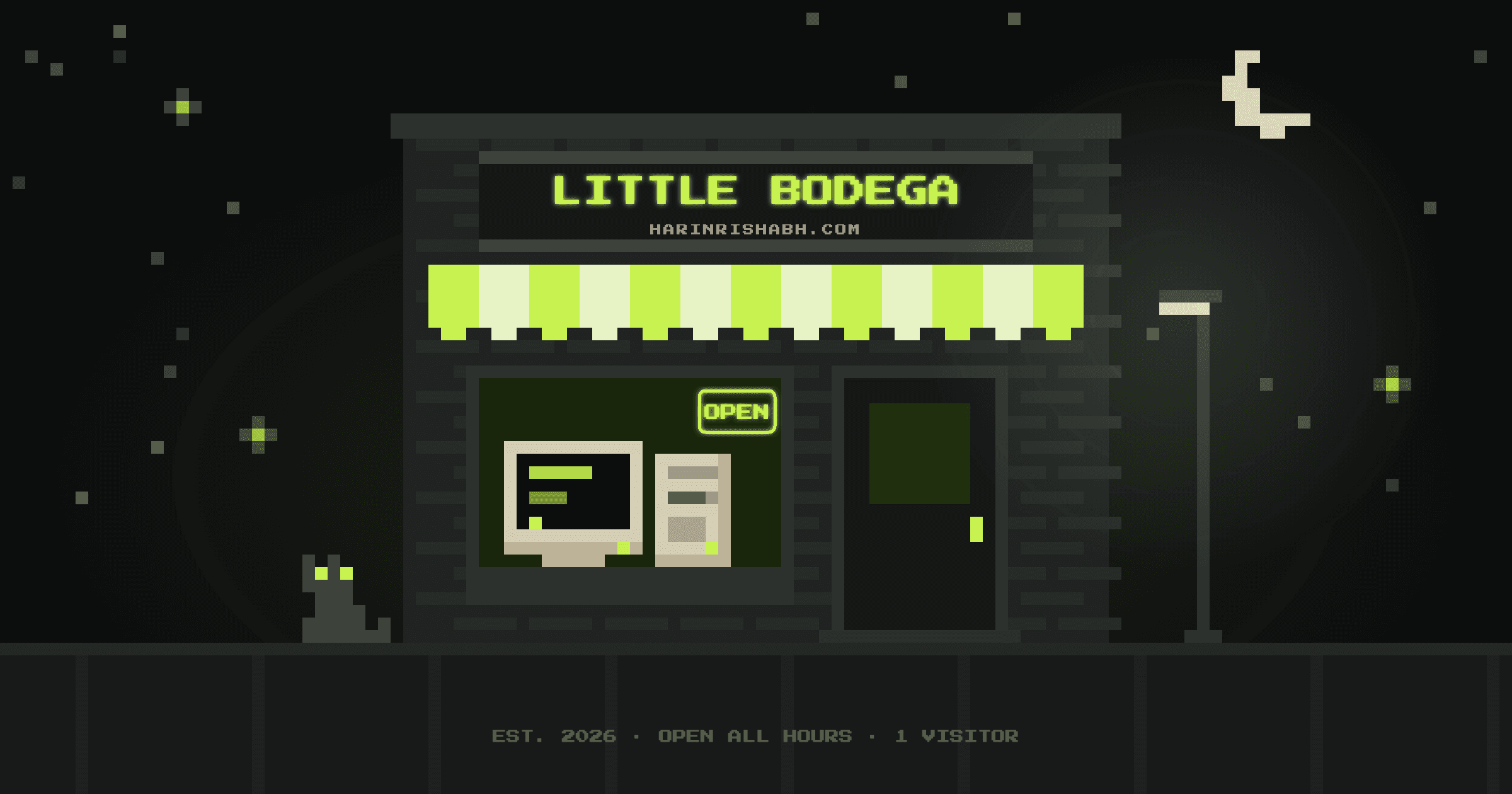
Recently, I came across a Medium article about the idea of having a small corner of the internet all to yourself. I tried dismissing the thought, finding excuses to put it off, but something about the idea stuck with me. A little bodega on the internet that belonged entirely to me. A place where I could put whatever I wanted, let my thoughts wander and write without worrying about being judged. I already spend most of my time learning new things on the internet or rambling to friends and family about the latest tech. So why not build a website that could double as a blog and a portfolio? If it helped me land my next big tech role, great. If not, I'd still have a little corner of the internet, free of paywalls, that I could revisit decades later and reminisce about how far I'd come, both as a person and as a tech professional.
I should also give a shout-out to a friend from a completely unrelated field (public health, I think?). She recently started a Substack where she writes about pretty much anything and everything in her life. I came across it on LinkedIn a few months ago, read one post, and found it so personal and interesting that I ended up subscribing and reading everything she wrote. So, thank you, friend. You were definitely part of the inspiration.
Building it anyway
And here I am, with 2027 just around the corner, right in the middle of the AI-generated content crisis, with my own pretty little website that I vibe-coded using Claude. Claude took care of most of the heavy lifting, although not without a ridiculous amount of back-and-forth over tiny details. I'm apparently very particular about how I want things to look, which meant plenty of prompting and tweaking before the website matched what I had in mind. That left me free to focus on what I actually wanted to do: write.
As counterintuitive as it sounds, this might be exactly the right time to build something personal and creative. We live in an era where AI can generate websites, build applications, write code and take care of an increasingly large part of software development. Perhaps that makes it even more worthwhile to create something of your own. Not because it's inherently impressive to build a website, but because what you put into it will always belong to you. No new model, however fancy, can take that away from you.
The bodega
Well, now I have my own little website and blog with exactly one visitor: me. Suddenly, it all felt familiar again. It had been well over a decade since that old 1 GB RAM ThinkPad and my Blogspot post that may have got thousands of people banned from FIFA 12. Somehow, I was that wide-eyed, geeky kid again, the one who loved tinkering with stuff and writing about it on the internet. Funny how life brings you back to things you thought you’d outgrown. Anyway, if you’ve made it to the end of my emotional ramble, welcome to my little stuck-in-time bodega on the ever-changing internet!
Go build something personal. There is no time like now.